Three different meanings of “season” Observation season describes when a source reports a species. Inshore movement describes where it may be at a time of year. Legal catch or retention rules govern what may be caught or kept. They are not interchangeable.
This reference uses the first two only. A highlighted month does not promise a sighting, a catch, permission to fish, food safety or sustainable stocks. A non-highlighted month does not prove absence. Check the relevant fisheries authority and local rules, including Cornwall IFCA where applicable.
Compare visible features and observation windows Name or visible feature Shape / group All Open-water fish Flatfish Sharks Small shore fish Observation month Any month Jan Feb Mar Apr May Jun Jul Aug Sep Oct Nov Dec Reset filters
Showing 9 of 9 reference species. This is not an identification verdict or a catch forecast.
Open-water fish
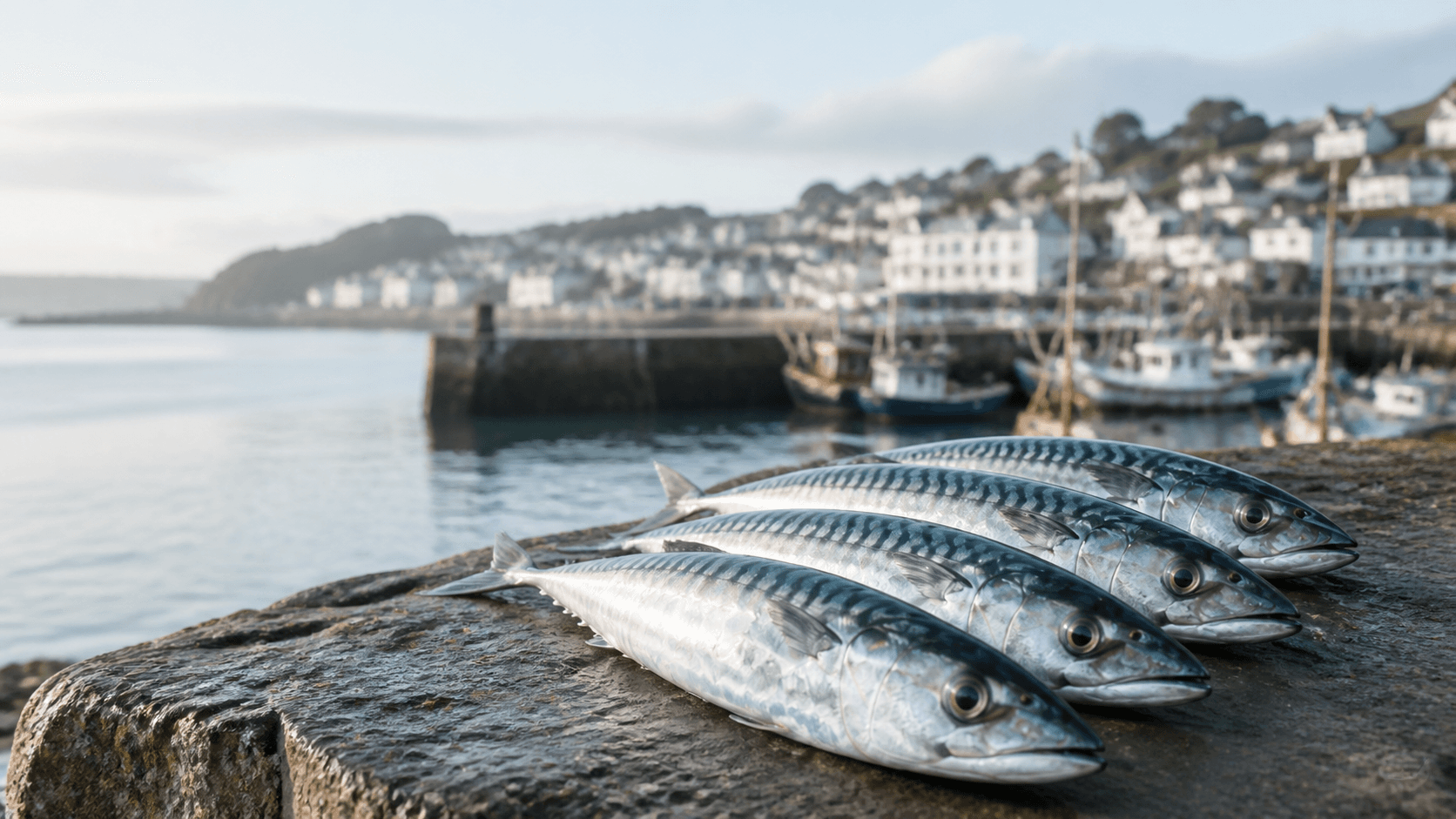
Atlantic mackerel Scomber scombrus
Look for Streamlined body; blue-green back with dark, wavy stripes. Habitat UK coasts; shoaling in open water. Reported season Recorded year-round; moves nearer shore in summer and farther offshore in winter. Jan Feb Mar Apr May Jun Jul Aug Sep Oct Nov Dec
Presence is not a forecast of a catch or a sustainability recommendation.
Compare the Wildlife Trusts identification page for Atlantic mackerel (opens in a new tab) Read our related atlantic mackerel guide
Open-water fish
European seabass Dicentrarchus labrax
Look for Silvery body with two dorsal fins; the first has prominent spines. Young fish can be spotted. Habitat Coastal waters and estuaries, especially southern and western coasts. Reported season Reported year-round; inshore summer movement and offshore winter movement. Jan Feb Mar Apr May Jun Jul Aug Sep Oct Nov Dec
Nursery areas and retention rules require separate, current local checks.
Compare the Wildlife Trusts identification page for European seabass (opens in a new tab) Read our related european seabass guide
Flatfish
Plaice Pleuronectes platessa
Look for Flattened, roughly diamond-shaped body with conspicuous orange spots on its upper side. Habitat Sandy seabeds and estuaries around the UK. Reported season The source lists observations throughout the year. Jan Feb Mar Apr May Jun Jul Aug Sep Oct Nov Dec
Do not identify a flatfish from colour alone; compare shape and other features.
Compare the Wildlife Trusts identification page for Plaice (opens in a new tab) Read our related plaice guide
Flatfish
European flounder Platichthys flesus
Look for Oval flatfish; small mouth and squared-off tail. Upper colour is variable; usually, but not always, right-eyed. Habitat Coasts and estuaries around Britain and Ireland. Reported season The source lists observations throughout the year. Jan Feb Mar Apr May Jun Jul Aug Sep Oct Nov Dec
Variable colour and eye-side make quick identification uncertain; compare the full source guide.
Compare the Wildlife Trusts identification page for European flounder (opens in a new tab) Read our related european flounder guide
Open-water fish
Black sea bream Spondyliosoma cantharus
Look for Oval silver fish with a small mouth and a long dorsal fin; breeding colour can differ substantially. Habitat South-west Britain, English Channel and Irish Sea. Reported season Present year-round in the source; nesting is described in April and May. Jan Feb Mar Apr May Jun Jul Aug Sep Oct Nov Dec
The source advises avoiding capture during the April–May breeding period. Check current local protections separately.
Compare the Wildlife Trusts identification page for Black sea bream (opens in a new tab) Read our related black sea bream guide
Sharks
Small-spotted catshark Scyliorhinus canicula
Look for Small shark with numerous dark spots, pale rough skin and cat-like eyes; also called lesser-spotted dogfish. Habitat Close to the seabed around UK coasts. Reported season The source lists observations throughout the year. Jan Feb Mar Apr May Jun Jul Aug Sep Oct Nov Dec
Compare with nursehound and other sharks; a common name alone is not a secure species identification.
Compare the Wildlife Trusts identification page for Small-spotted catshark (opens in a new tab) Read our related small-spotted catshark guide
Small shore fish
Two-spotted goby Gobiusculus flavescens
Look for Tiny slender fish; males have dark spots behind the pectoral fin and near the tail. Females show the tail spot. Habitat Among seaweed and seagrass around Britain and Ireland. Reported season The source's observation window is March–October, not proof of absence outside those months. Jan Feb Mar Apr May Jun Jul Aug Sep Oct Nov Dec
Observe in place and avoid disturbing shelter or habitat.
Compare the Wildlife Trusts identification page for Two-spotted goby (opens in a new tab) Small shore fish
Shore clingfish / Cornish sucker Lepadogaster purpurea
Look for Small reddish-brown fish with a flattened head, broad snout and two turquoise marks behind the eyes. Habitat Rocky shores, particularly south-west England, Wales and south-west Scotland. Reported season The source's observation window is April–October. Jan Feb Mar Apr May Jun Jul Aug Sep Oct Nov Dec
Fish may guard eggs beneath rocks; do not disturb a shelter for a photograph.
Compare the Wildlife Trusts identification page for Shore clingfish / Cornish sucker (opens in a new tab) Small shore fish
Lesser weever Echiichthys vipera
Look for Small sand-burying fish with upward-facing eyes and mouth and a dark first dorsal fin. Habitat Sandy shallows, especially southern and south-western Britain. Reported season The source's observation window is June–October; this is not a statement that other months are risk-free. Jan Feb Mar Apr May Jun Jul Aug Sep Oct Nov Dec
Venomous spines: do not handle it or use this reference as treatment advice.
Compare the Wildlife Trusts identification page for Lesser weever (opens in a new tab) Record what you observed, not what you hoped to catch Record the date, broad location and habitat without disturbing the animal. Note body shape, fin positions, markings and approximate size; a single colour or common name can mislead. Compare the full linked species page. If uncertain, label the record “unconfirmed” and seek an experienced local naturalist’s help. Do not handle an unfamiliar fish for a photograph. This reference includes a venomous species and is not first-aid guidance. These nine entries are a bounded comparison, not a complete guide to British fish. Photographs on linked sources are useful for comparison and are not reproduced here.