
Useful for your next trip
Useful kit connected to this guide, chosen to keep the next step simple.
Full what crab is this? a guide to common crabs on uk shores guide
How to spot it, where it lives, how it is caught and how to cook it — the complete guide, in one easy read.
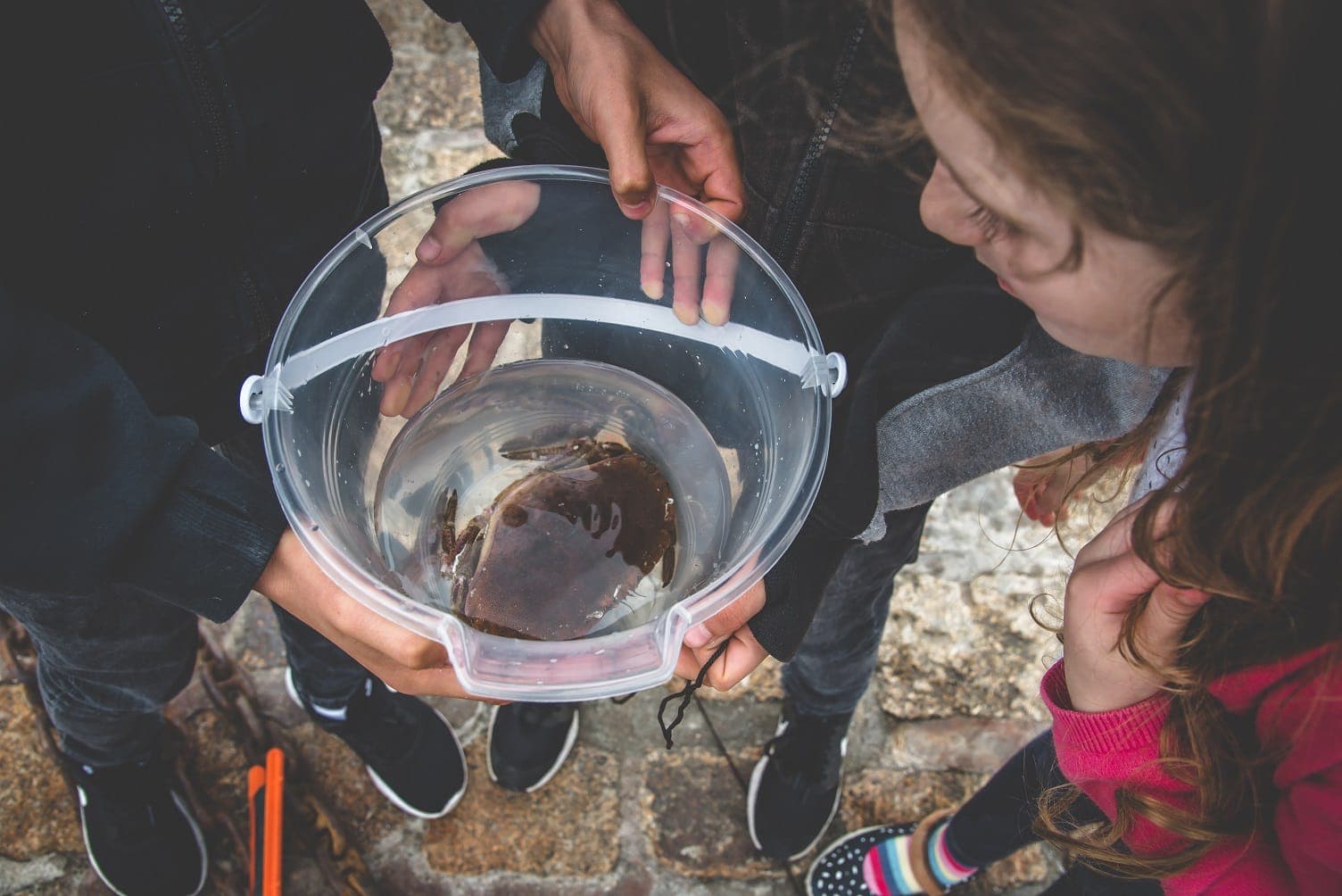
The crab in your bucket is almost certainly a shore crab: a green, orange or reddish crab up to about 9cm across with five spikes along each side of its shell, and it is the species that fills most crabbing buckets around the UK. If it has a smooth brown shell with a pie-crust edge and black-tipped claws it is a young edible crab, and if it has bright red eyes, a fuzzy shell and flat paddle-shaped back legs it is a velvet swimming crab, which nips hard. Below we go through the seven crabs you are most likely to meet on UK shores and how to tell each one apart, then how to tell a male from a female, what to do with berried crabs, how to handle crabs safely, the legal sizes if you want to keep an edible crab, and the two invasive crabs you should report.
Shore crab (green crab): the one you will catch most
The shore crab, Carcinus maenas, is the crab most people meet while rock pooling or crabbing, and it lives all around the UK coast. Adults reach a shell width of up to about 9cm (3.5 inches), though most of the crabs that come up on a harbour line are 3 to 6cm across.
Despite the name green crab, colour is a poor guide. Young shore crabs can be patterned in white, black and green, adults are usually dark green, and older crabs that have not moulted for a while turn orange or red underneath. The reliable feature is the shell edge: five sharp, forward-pointing spikes on each side of the shell behind the eye, and three rounded bumps between the eyes. Rock poolers remember it as 5, 3, 5.
Shore crabs eat almost anything, from seaweed and mussels to barnacles and smaller crabs, which is why they are so easy to catch on a baited line. Their pinch is more of a surprise than an injury for an adult.
Edible crab (brown crab): the pie-crust crab
The edible crab, Cancer pagurus, is the one you buy from the fishmonger. Adults are usually 10 to 20cm (4 to 8 inches) across the shell, but the ones you meet on the shore or on a crab line are juveniles, often only a few centimetres wide. Big adults live on the lower shore and in deeper water down to around 100m.
It is easy to identify at any size. The shell is a smooth, thick oval, brown or reddish brown, and the front edge has a row of rounded lobes that look like the crimped edge of a pie. The claws are big and heavy compared with the body, and the tips of the pincers are black.
Edible crabs are built for crushing shellfish, and even a palm-sized one can give a properly painful squeeze. Of the common UK crabs, a big edible crab has by far the most powerful grip, so keep your fingers away from the claws.
Velvet swimming crab: red eyes and a bad temper
The velvet swimming crab, Necora puber, grows to around 10cm across the shell and is found on all UK coasts, in rock pools and shallow water below the tide line. Look for bright red eyes, a shell covered in short soft hairs that gives it a velvety look, blue lines on the legs and bluish tips to the claws.
The giveaway is the back pair of legs, which are flattened into paddles. Velvets use them to swim fast, which is how they catch fish and prawns as well as eating worms, clams and sea snails.
Velvets are famously feisty. Disturb one and it rears up with its claws held wide apart, ready to fight. It is quick and will give a painful nip, so it is the crab most likely to make a child drop the line. If you catch one, tip it gently into the bucket rather than trying to pick it up.
Spiny spider crab: long legs and a spiky shell
The spiny spider crab, Maja brachydactyla, is a big orange crab with a spiky, oval shell up to about 20cm long and long, spindly legs. Its shell is often covered in seaweed and sponges, which gives it a hairy, green look and helps it hide. It is common along the south and west coasts of England and Wales, and absent from the North Sea, Scotland and northern England.
You are unlikely to catch an adult on a crab line, but snorkellers and divers in the South West see them in shallow water in summer, when they sometimes gather in large numbers on sand or rock in the shallows. They head back to deeper water in autumn. Small spider crabs do turn up in rock pools and occasionally on crab lines from harbour walls.
Spider crabs are slow and rarely aggressive, but their claws can still pinch, so handle them gently from behind.
Hermit crab, broad-clawed porcelain crab and Montagu's crab
Hermit crab: the common hermit crab, Pagurus bernhardus, has a soft body around 3.5cm long that it protects by living in an empty sea snail shell, usually a periwinkle or, for bigger crabs, a whelk. It is reddish brown and its right claw is noticeably bigger than its left, which it uses to block the shell entrance. As it grows it moves into larger shells, and hermit crabs will fight over a good one. Look for a shell that suddenly walks off in a rock pool. Never pull a hermit crab out of its shell: you will injure it.
Broad-clawed porcelain crab: Porcellana platycheles is tiny, up to about 15mm long, with a rounded, hairy, greyish brown shell and enormous flattened hairy claws that look far too big for it. It appears to have only three pairs of walking legs, because the fifth pair is small and tucked away. You find it by turning stones on the middle and lower shore, especially where there is mud and gravel underneath. It is fragile and sheds legs easily, so let it walk onto your palm rather than grabbing it, and put the stone back the way you found it.
Montagu's crab: Xantho hydrophilus, also called the furrowed crab, is a small, chunky crab with a broad, grooved shell and big claws with black tips, found under stones on rocky shores and quick to bury itself in gravel. Because of the black claw tips it is often confused with a young edible crab. Look at the front edge of the shell: an edible crab has the neat pie-crust lobes, while Montagu's crab has deep grooves running across a broader, more muscular-looking shell. Despite the big claws, it is fairly docile.
Which crabs will you catch crabbing from a harbour wall?
Almost all of them will be shore crabs. On a good summer day with a baited line or a crab drop net, you may also pull up the odd small edible crab, a velvet swimming crab or, in the South West, a young spider crab. Hermit and porcelain crabs live on the shore itself rather than around harbour walls, so you find them by rock pooling instead.
Our guide to responsible family crabbing covers setting up, how long to keep crabs and releasing them, and our guide to UK crabbing season and the best crabbing spots covers when and where. For what to put in the bait bag, see the best bait for crabbing. To find crabs on the shore, our rock pooling with kids guide explains how to search safely, and our tide times show you when the shore is uncovered.
How do you tell a male crab from a female?
Turn the crab over, or look at it from underneath through a clear tub. Folded tight against the underside is the abdomen, sometimes called the apron or tail flap. In a male it is narrow and pointed, roughly a slim triangle. In a female it is much broader and rounded, because she uses it to hold her eggs. This works for shore crabs, edible crabs, velvets and most other true crabs, though it is harder to see on very small juveniles.
In edible crabs there are other clues. Males have noticeably bigger claws, so they carry more white meat, while females tend to have more brown meat in the body shell.
A female carrying eggs is called berried. You will see a spongy mass of tiny eggs under her abdomen, usually orange or reddish at first and turning darker as they develop. Always put berried crabs back straight away, whatever the species, gently and in the water. Each one is carrying the next generation. For edible crabs it is also the law in many areas: several Inshore Fisheries and Conservation Authority (IFCA) districts in England ban taking berried or soft-shelled edible crabs, so check the byelaws for where you are fishing.
How do you pick up a crab without getting nipped?
Step 1: wet your hands first and come in from behind, where the claws cannot reach.
Step 2: place your thumb and forefinger on either side of the back of the shell, behind the last pair of legs, and lift. A crab held this way can wave its claws but cannot reach round to your fingers.
Step 3: never pick a crab up by a leg or a claw. Crabs can drop a limb to escape, and although it grows back over the next few moults, it costs the crab dearly. With feisty crabs such as velvets and larger edible crabs, it is better not to pick them up at all: tip them gently from the net or bucket instead.
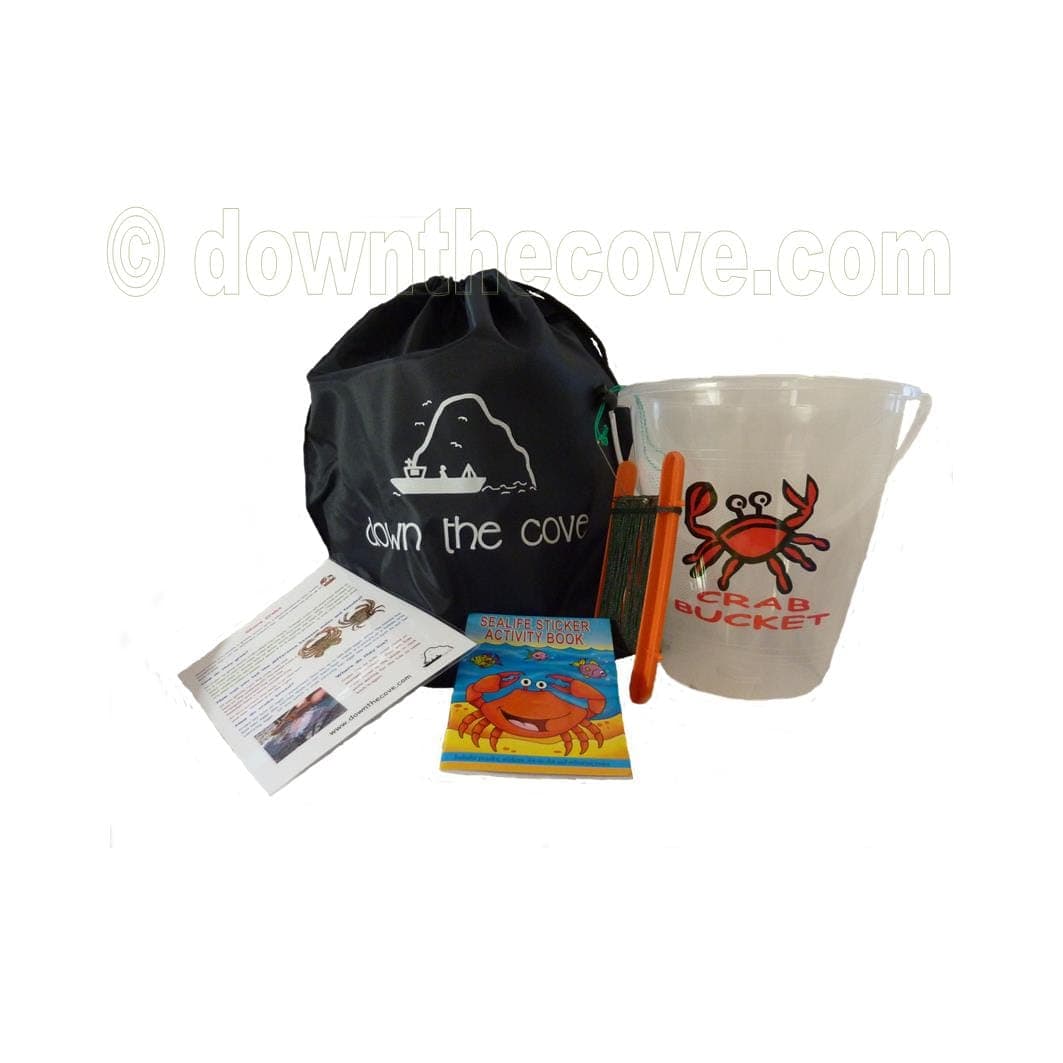
Keep crabs in a bucket of fresh seawater in the shade, with not too many in at once, and change the water often, because it warms up and loses oxygen quickly in the sun. Our Kids Crabbing Kit with Bucket, Line and Guide has everything for a first session. Release them within an hour or so by tipping the bucket gently at the water's edge, never by dropping them from the top of a harbour wall.
Can you keep an edible crab? Minimum sizes and limits
Yes, if it is big enough and you follow the local rules. Edible crab sizes are measured across the widest part of the shell, and they vary around the UK. In English waters west of 2°56.78′W and south of 52°N, which covers Cornwall, Devon and the Bristol Channel, the minimum conservation reference size is 150mm (about 6 inches) for females and 160mm (about 6.3 inches) for males. This was harmonised across South West English waters from 1 February 2026 and matches the long-standing Cornwall IFCA byelaw. Elsewhere in the UK the national sizes are mostly 130mm or 140mm depending on the area, and local byelaws can be stricter, so check the UK minimum conservation reference sizes and your local IFCA, or the Scottish Government, Welsh Government or DAERA in Northern Ireland outside England.
Other crabs have sizes too. Nationally, spiny spider crabs must be at least 130mm for males and 120mm for females, and velvet swimming crabs at least 65mm (70mm in the Outer Hebrides and Orkney). In the Cornwall IFCA district the spider crab minimum is 130mm. The crabs you catch on a harbour line are almost always well under these sizes, so they all go back.
In Cornwall, Cornwall IFCA's recreational rules say that if you are fishing from a boat without a permit, you may take no more than five shellfish a day in total from lobster, crawfish, edible crab and spider crab, with no more than two of them lobster or crawfish. From the shore there is no number limit, but the minimum sizes and other conditions still apply. If you do keep a legal-sized crab, our guide to cooking a live crab and our article on why crabs are cooked alive, and a kinder way explain how to dispatch it humanely.
Which invasive crabs should you report, and how?
Two non-native crabs are worth knowing, because early records help scientists track and slow their spread.
Asian shore crab: Hemigrapsus sanguineus was first recorded on mainland Britain in 2014, at Barry Island in Wales and in Kent. It is small, with adults around 35 to 42mm across, and has a distinctly square shell with three spines along each side, colouring from orange-brown to green-purple, and legs banded light and dark. It lives on rocky shores, in rock pools and under boulders, and can compete with native shore crabs and young edible crabs. Compare it with the shore crab's five spikes per side.
Chinese mitten crab: Eriocheir sinensis lives mostly in rivers and estuaries, and is the only crab in the UK found in fresh water. It has a squarish greenish brown to dark brown shell and, in adults, dense mats of brown hair on the claws, which have white tips. It damages riverbanks and fishing gear and competes with native wildlife.
To report either one, take a clear photo, note how many you saw and the exact place, date and time, and submit it through iRecord, iNaturalist UK or by email to the Marine Biological Association. The Natural History Museum's Mitten Crab Watch page has the current links. Do not put a suspected invasive crab back into the water or take it somewhere else alive.
Quick crab ID checklist
Check four things: the edge of the shell behind the eyes, the shape of the back legs, the eyes and claw tips, and how the crab behaves. Colour is the least reliable clue, because the same species can be green, orange or red depending on age and moulting. A clear tub lets you look underneath without picking the crab up, and a pocket guide such as I-Spy At The Seaside is handy for children to tick off what they find.
Five sharp spikes each side, green, orange or red: shore crab. Smooth brown shell with a pie-crust edge and black claw tips: edible crab. Red eyes, fuzzy shell, paddle back legs: velvet swimming crab. Spiky oval shell, long legs, often weedy: spiny spider crab. Living in a snail shell: hermit crab. Tiny, under a stone, huge flat hairy claws: broad-clawed porcelain crab. Small and chunky with black-tipped claws and a grooved shell: Montagu's crab. Small and square with three spines each side and banded legs: possibly an Asian shore crab, so photograph it and report it.
Whatever you find, keep it cool and wet, handle it from behind, put berried females back straight away and return everything you do not keep to the water's edge.
FAQs
Quick fish questions
Short answers for the questions families and coastal readers often ask first.
Is what crab is this? a guide to common crabs on uk shores good to eat?
Yes. What Crab Is This? A Guide to Common Crabs on UK Shores can be a lovely fish to cook at home when it is fresh and handled well. We will add more specific cooking notes here as we refine this guide.
Where is what crab is this? a guide to common crabs on uk shores usually found?
The habitat notes for what crab is this? a guide to common crabs on uk shores are covered in the guide above, including the kind of ground and coastal areas it is usually associated with.
What bait is used for what crab is this? a guide to common crabs on uk shores?
The bait notes in this guide mention: ed line. Their pinch is more of a surprise than an injury for an adult. Edible crab (brown crab): the pie-crust crab The edible crab, Cancer pagurus, is the one you buy from the...
Can children learn about what crab is this? a guide to common crabs on uk shores from this guide?
Yes. These fish guides are written to be useful for families, beginners and curious coastal readers, with plain-English notes before the more detailed guide.
Is what crab is this? a guide to common crabs on uk shores sustainable?
Sustainability depends on where and how the fish was caught, plus current stock advice. We recommend checking up-to-date guidance before buying or keeping any fish.