
Safety
Foam lifejacket
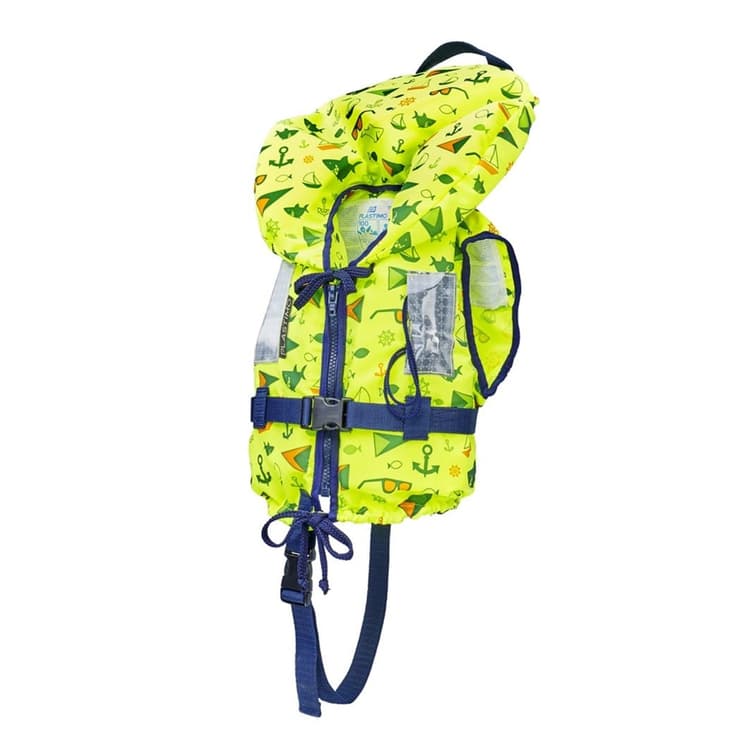
- Wrap-around collar
- Crotch strap
- Whistle
- Grab handle
- Reflective patches
A lifejacket is not a substitute for supervision. Always keep children closely watched near water.

Safety
Details
Plastimo spells it Typhon in France, so you may see it as the Plastimo Typhon 100N lifejacket; it's the same jacket. It's made of polyethylene foam, so it floats straight away with nothing to inflate or re-arm. The large wrap-around collar is designed to keep a child's head out of the water.
It closes with a full zip and an adjustable waist belt with a plastic buckle, plus a drawstring at the hem for a snug fit. The crotch strap fastens between the legs and must always be done up, because it stops the jacket riding up over the child's face. The whistle, grab handle and reflective patches help someone find and lift a child from the water.
Choose by weight, not age: S for 3 to 10kg (about 1 to 2 years), M for 10 to 20kg (about 2 to 5) and L for 20 to 30kg (about 5 to 8). Fit it with the belt and crotch strap fastened, then hold the jacket at the shoulders and lift gently. The jacket shouldn't move up. If it does, tighten the straps, and if it still rides up, try a smaller size. Buy the size that fits now, not one to grow into.
Level 100 is for sheltered and calm water, as the RNLI advises: harbours, estuaries, crabbing from a quay, or a small boat in a sheltered harbour in calm conditions. For days like that it's a sensible kids life jacket. Among life jackets, 100N is the lowest lifejacket level. Plastimo describes its 100N jackets as designed to turn most wearers face-up, but the RNLI notes that a level 100 lifejacket may not roll an unconscious person on to their back. A 100N life jacket is not a swim aid, and it never replaces an adult watching within arm's reach. For coastal and offshore boating, choose level 150 or above.
Specifications
Compare
 This lifejacketYou're here
 Plastimo 100N Child's Lifejacket
How to use
Choose S, M or L by weight.
Zip, belt and crotch strap.
Lift the jacket at the shoulders; it shouldn't move up.
Every review is shown, low scores included. The breakdown chart appears from 10 reviews.
FAQs
Choose by weight: S for 3 to 10kg, M for 10 to 20kg and L for 20 to 30kg. Plastimo says only the child's weight counts when choosing a size. Fit it snugly with the crotch strap done up, and buy the size that fits now.
A large wrap-around collar to support the head, a crotch strap, a full zip with an adjustable waist belt and buckle, a hem drawstring, a whistle, a grab handle for lifting a child from the water, and reflective patches.
Polyethylene foam. It floats as soon as it's in the water, with no gas cylinder to check or replace. Plastimo says the buoyancy is higher than the minimum the standard requires. Check the foam regularly, as foam compresses with age.
No. A lifejacket helps a child float, but it isn't a guarantee. The RNLI says a level 100 jacket may not have enough buoyancy to protect someone who can't help themselves, and may not turn them on to their back. Always keep children within reach and in sight near water.
No. Level 100 is meant for sheltered and calm water, such as harbours and estuaries in calm conditions. For coastal and offshore boating choose level 150 or more. For paddlesports such as kayaking, a level 50 buoyancy aid is usual. Neither is a swimming aid.
It's a lifejacket. A level 50 buoyancy aid helps a swimmer who can help themselves; a level 100 childs lifejacket like this one has more buoyancy and a collar designed to keep the head up. Our lifejacket or buoyancy aid guide explains the difference.
Both. The label says Typhon, the French spelling, and Plastimo's English listings and UK shops say Typhoon, so it's often called the Plastimo Typhoon life jacket. Kids' sizes are the same under either name: the Typhoon life jacket kids wear here comes in S, M and L, and the Plastimo Typhoon 100N and Plastimo Typhon 100N are the same lifejacket.
Follow the care label. Rinse it in fresh water after use in the sea and dry it away from direct heat. Check the foam, fabric, stitching, zip and buckles regularly, and replace the jacket if the foam is squashed, torn or no longer springs back.
Still deciding?
We are a small family-run shop. Ask us anything before you order.
Send us a message support@downthecove.comDelivery and returns
Packed and posted by our own small team.
For the beach


 Est. 2012
Down The Cove · founded in Cornwall, 2012
We donate 1% of all profits to Compassion UK, supporting its work with children and communities facing poverty: clean water, healthcare and education. Compassion UK is an independent charity. Visit Compassion UK
