

Nice placemats
These placemats worked better once everyone was sitting down and eating.
S. Young · 11 Oct 2026

Details
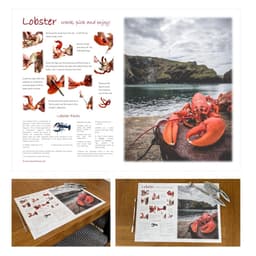
Eating a lobster for the first time can be daunting, so we designed these placemats to talk your guests through it at the table. They're large placemats at A3 (42 x 29.7cm), with room for a plate on one side and the instructions on the other, and as far as we know, no one else in the UK makes a how to eat a lobster placemat like them.
The six steps, each with a photo: lift the meat out of the tail with a fork; twist off the claws and the legs; pick out the meat in the body where the legs joined; crack the claws with crackers or a hammer; squeeze the legs to push the meat out; and break apart the joints to get at the small pieces. Our guide to how to eat a lobster goes into more detail.
The lobster facts box covers things guests like to talk about: why a lobster turns from dark blue to red when it's cooked, that it chews its food with teeth in its stomach, that it tastes with its legs, and that it can grow back claws, legs and antennae.
The photograph is ours, taken down the cove at Mullion in Cornwall. Cornish lobsters are caught mainly in pots, which the Cornwall Good Seafood Guide calls a selective, low-impact fishery, and in Cornwall a lobster's shell must measure at least 90mm from the eye socket to the back of the carapace before it can be landed. The National Lobster Hatchery in Padstow releases thousands of young lobsters around the coast every year.
Our plain lobster paper placemats are 90gsm and meant to be thrown away after a messy meal, like any disposable placemats; the ink isn't designed for food to sit on, so use plates. Laminated ones wipe clean and can be used again. The 25 and 50 packs of A3 paper lobster placemats suit pubs, seafood restaurants, holiday lets and lobster nights, and we can supply more than 50 if you ask. All placemats are posted flat, not rolled.
For a lobster night at home, lay a mat at each place with a pair of crackers, a pick, a finger bowl and plenty of napkins, and keep a bowl on the table for the shells. Guests can follow the steps as they go, and the facts box gives everyone something to talk about.
Specifications
Compare
 How to eat a lobster placematsYou're here
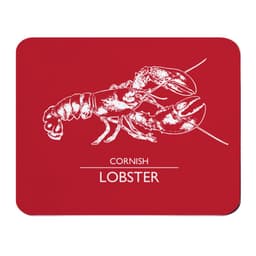 Cornish lobster tablemat
These placemats worked better once everyone was sitting down and eating.
Bought this set of placemats for my brother and he was made up with them. The set worked better once everyone was sitting down and eating. 🎣
Used these placemats for a seafood dinner and people actually read them at the table. It is the sort of thing I would bring out for another seafood meal.
FAQs
Plain paper placemats are 90gsm and meant for one meal: throw them away afterwards. The ink isn't made for food to touch, so use plates. Laminated placemats are sealed, so you can wipe them clean and use them again for the next lobster supper.
A3, which is 42 x 29.7cm. That's bigger than a typical restaurant paper placemat, with room for a plate on one half and the six photo steps and lobster facts on the other, so everyone can follow along while they eat.
Packs of 2, 4, 6, 10, 25 or 50, in paper or laminated. The larger packs suit pubs, restaurants and lobster nights. If you need more than 50, get in touch and we'll quote for a bigger order.
Flat. We ship them flat, not rolled, so they're ready to lay on the table straight away with no curling at the corners, whether you order 2 or 50. If you need them by a set date, order a few days ahead.
No, just the placemats; the crackers and pick in our photos are props. We stock lobster and crab crackers and seafood shears separately if you need the tools to go with them.
We did. The step-by-step photos and the lobster picture are our own, taken in Mullion, Cornwall, and we wrote the lobster facts on the mat. If you'd like a different quantity or a bigger order for a restaurant, just ask us.
Still deciding?
We are a small family-run shop. Ask us anything before you order.
Send us a message support@downthecove.comDelivery and returns
Packed and posted by our own small team.
 Est. 2012
Down The Cove · founded in Cornwall, 2012
We donate 1% of all profits to Compassion UK, supporting its work with children and communities facing poverty: clean water, healthcare and education. Compassion UK is an independent charity. Visit Compassion UK