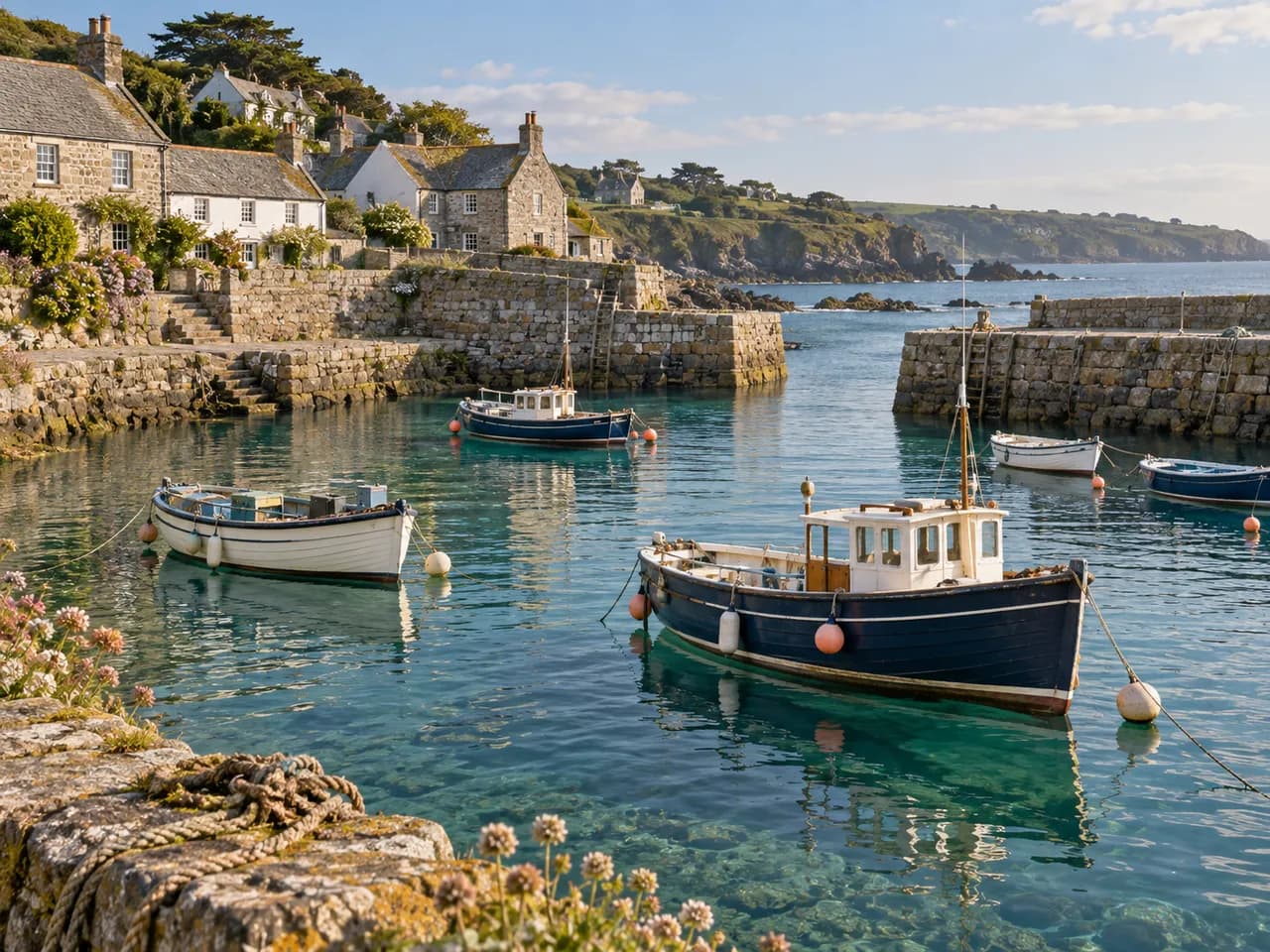
Godrevy lies at the far end of St Ives Bay, where the bay's long sweep of sand gives way to a rocky headland and the open Atlantic beyond. The beach itself is broad and golden at low water, softening into marram-covered dunes at the back, while the cliff path climbs away towards Hell's Mouth and the wider Godrevy to Portreath headland. It is a beach that draws all sorts on the same afternoon: surfers chasing the swell, families digging in for the day, and walkers simply pausing to take in the view across the water to St Ives.
The white octagonal tower of Godrevy Lighthouse holds the eye from almost anywhere on the sand. Standing on its small island offshore, it rose in the 1850s to warn ships off the treacherous Stones reef and was kept by lighthouse keepers until 1934, when it was automated. Its quiet presence on the horizon is widely linked with Virginia Woolf, who summered nearby as a child and is thought to have drawn on it for To the Lighthouse.
Beyond the main beach, a short walk along the coast path leads to Mutton Cove, where Cornwall's largest colony of grey seals gathers below the cliffs. Looking down from the headland, you can often watch them hauled out on the sand to rest, moult and nurse their pups, with autumn and winter the surest seasons. It is a reminder that for all its popularity in summer, Godrevy remains a working stretch of wild coast.