
The full guide
Read straight through, or use the seafood notes above to keep buying, cooking and serving simple.
How to gut a Fish
When you buy fish from a fishmonger they are usually already gutted. If you catch your own fish or buy fish that have not already been gutted it is important to do this to remove the guts.
The demonstration we have shown here is gutting a mackerel but the method is the same for all round fish.
How to Fillet fish
Filleting a fish is removing as much of the flesh as possible but leaving all the bones behind. This is a preferred method of serving fish to people not used to eating fish as many people find sifting through bones or finding bones in their dinner very off putting. We have demonstrated how to fillet three different types of fish in our videos. The basic method is the same in that you make an incision just behind the pectoral fin and then run the blade horizontally next to the main central bone towards the tail of the fish.
For larger fish like cod, pollack and haddock this will take several passes of the knife gradually working your way towards the back of the fish.
Filleting is something that takes practice and unfortunately, until you master it, your family may well have to endure the odd bones! It is worth persevering though as a lovely boneless fillet of freshly caught fish is a treat for anybody.
Filleting a Mackerel
Filleting a Plaice
Filleting a Whiting
Skinning a Fish Fillet
How to remove the skin from a whiting fillet
If you are planning on freezing your fish to eat at a later date then it is best to leave the skin on when your freeze it. When you remove it from the freezer, run it under the tap for a few seconds and then the skin will peel off easily.
If you want to skin it straight away then you will need to run a filleting knife between the flesh and the skin starting from the tail end. While doing this hold on tightly to the skin at the tail end. This is demonstrated in our video below.
Knives
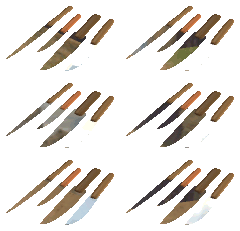
If you go into an angling shop you will have a choice of knives ranging from bait knives, gutting knives, filleting knives and penknives. It is not necessary to have all these different types of knife. A filleting knife can be used for cutting bait, gutting and filleting and the only other knife needed would be a small penknife for cutting fishing line and small strips of bait.
A good filleting knife should have a thin flexible curved blade and the blade should be at least 6" (150mm) long. Some filleting knives have sheaths to protect both blade and fingers and some have buoyant handles so that they float if dropped overboard!
Please be aware of the current laws regarding knives and where they may be used. We only sell knives to people aged over 18
Common questions
- How do you gut a round fish?
- Slit the belly from the vent up towards the head, lift out the guts, and rinse the cavity clean. The method is the same for all round fish, such as mackerel, whiting and pollack.
- How do you fillet a fish?
- Make an incision just behind the pectoral fin, then run the blade flat along the central backbone towards the tail, lifting the fillet cleanly off the bones. Repeat on the other side.
- How do you skin a fish fillet?
- From the tail end, run a filleting knife between the flesh and the skin while holding the skin tight. If you froze the fillet with the skin on, a quick rinse under the tap lets the skin peel away easily.
- What knife do you need to fillet fish?
- A thin, flexible, curved filleting knife with a blade at least 6 inches (150mm) long. One good filleting knife will handle gutting and filleting; you do not need a drawer full of blades.
- Do I need to gut fish straight away?
- Yes — gut fish as soon as you can after catching it. Prompt gutting keeps the flesh fresh and firm and helps to reduce the fishy smell.
- How do you clean a mackerel?
- Mackerel have tiny, soft scales, so you can usually skip scaling and simply rinse the fish under cold water. Slit the belly from the vent to the head, lift out the guts, and scoop away the dark bloodline along the backbone with a thumbnail or teaspoon, as mackerel have a pronounced one that can taste bitter if left. Take care not to burst the gall bladder, then rinse the cavity and pat dry.
- Which fish need scaling before filleting?